Showing posts with label literature. Show all posts

Wednesday, March 11, 2009

Belgium, Belgium, Belgium! (sorry for the profanity)

Not sure why I've let this layer of dust accumulate over things lately, meant to post a thing or two last week, but things got away from me I guess.

Nothing personal, I assure you--well, most of you anyway.

So what got me riled up enough to break my silence?

This monstrosity:
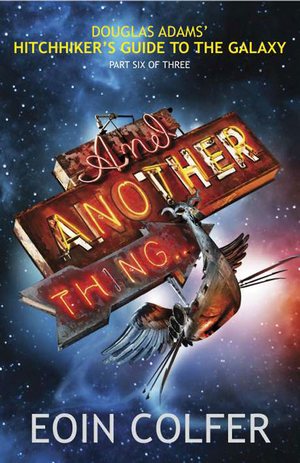


That's right, author Eoin Colfer has been commissioned to write the sixth volume of Douglas Adams' Hitchhiker's Guide trilogy.

SciFi Wire reports:
And Another Thing..., which will be released Oct. 12 to coincide with the 30th anniversary of the publication of the first book in the series by the late Douglas Adams, is a sequel commissioned by the publisher from Eoin Colfer. Colfer is the author of the best-selling Artemis Fowl series.

While Penguin will publish the latest book, Pan Macmillan, which was Adams' paperback publisher, will repackage his backlist, adding new introductions to the books, which will be released monthly leading up to the release of the new title.
Why, oh why, is this being done? Was the world begging for a follow-up to Mostly Harmless? Did another story just need to be told? NO!

Did Adams' leave notes, instructions for another? No.

Does Arthur Dent really need to get kicked around some more? No.

Wouldn't it be easier to insult the Douglas Adams' memory by digging up his bones and throwing rocks at them? Or you could just put out the recent movie on Blu-Ray, that'd do it, too.

This is wrong, wrong, wrong, wrong, wrong. A travesty. A disgrace. A literary crime.

Oh, who am I kidding? I'll be there on 10/21, cash in hand, just waiting for the book--probably with baited breath. Just hope it'll be slightly better than a collection of poetry by Paula Nancy Millstone Jennings of Greenbridge, Essex, England.

Thursday, July 03, 2008

Science Fiction, Gender Balance, Marxism/Collectivism and My Kind of Male Chauvanist

I really need to spend time editing these post titles...

Whilst trying to come up with something to post today, I made a mistake--I read something great. Sometimes reading something I appreciate will inspire me, other times it'll just intimidate me. Today, I was intimidated, I read two posts that were thought-provoking, skillfully argued, with some killer lines...oh, and they had the added bonus of being right.

John C. Wright is one of my favorite living science fiction writers, even tho I have yet to really get into one of his novels. But I love reading his blog, and trust that one day, I'll appreciate his fiction. Yesterday, he responded to an online panel discussion about gender balance in genre fiction with two great posts, "Gender Balance in Genre Fiction" and "The Coldness of the Heretics." Even if you don't care about Science Fiction publishing (or genre publishing in general), they're worth the read.

In the first post, he talked about his own position, and pointed to a take he appreciated (as did I). Am sure he's correct when he said, "I doubt this will be the most popular response." But his explanation for his doubt is phrased perfectly: "In an age when thin-skinned whining is regarded as a moral good, stoicism is regarded as unethical." (gotta get that one committed to memory for future use)

In his last four paragraphs he gives a summary of what it is to act like a man--not unlike Brad Miner's view, just put in a pithier manner. In short, "If male chauvinists like me really want to be male chauvinists, we have to be male chivilrists as well, in which case we cannot treat womanhood with other than courtesy and fearful reverence."

In Wright's second post, he really lets loose, reacting to a comment to the panel, which stated in part:

I would argue that to consciously embrace and celebrate the dominant culture through an act of writing, editing or publishing - or even reviewing/acknowledging -- knowing the inequities and injustices that the dominant culture is built on, is an unethical act that perpetuates the worst of that culture's inequities and injustices.
Wright responds:
I hope the disproportionate absurdity of the sentiment expressed speaks for itself (it is an unethical act to review or acknowledge a book complimentary to Western values, because the West is built on evil. So don’t review STAR WARS or acknowledge STAR TREK because Virginian planters kept black slaves, the Romans conquered the Gauls, and the Homo Sapiens wiped out the Neanderthals).

I hope the illogic involved is likewise obvious (Only within the ethical context of Western values, Judo-Christian and Greco-Roman ideals of justice, individualism, and pity for the underdog, it is regarded as an evil to side with one’s forefathers against the stranger or sojourner when one’s forefathers are arguably in the wrong. Oriental ethical systems make patriotism and family loyalty paramount. The Muslim has a broader standard, since Islam is a universalist religion, but no pity is obligated for the infidel, but instead, a positive obligation to war, to pillage and to conquer. Hence, we cannot reject the West except from Progressive philosophical ground; but Progressivism is unique to the West, a heresy of the Enlightenment, so to speak, that can grow out of no other intellectual tradition.)

So seeing no need to dwell further on the lack of proportion and the lack of logic, I should like to emphasize the dismal coldheartedness of the world-view expressed. I submit that it is an inhuman world view.
Wright follows that with a 2400-word worldview apologetic against "that inhuman worldview" (Marxism/collectivism) that he'd do well to expand and publish (as well as cleaning up the typo 'Judo-Christian', as fun an idea as that is)--he attacks Marxism on political, moral, and aesthetic grounds.

Wright's well worth your time, particularly on these two posts.

Wednesday, May 23, 2007

I can't believe I almost forgot this date

Towel Day :: A tribute to Douglas Adams (1952-2001)

but nothing to panic about...I remembered.

Saturday, March 17, 2007

The Lorica/Saint Patrick’s Breastplate

Well, it's St. Patrick's Day (incidentally, he's never been canonized by the Roman Catholic Church--so why the "St."?), so might as well post something attributed to him--this poem may date from the eighth century and so post-date Patrick. But it is traditionally assigned to him.

The other day at work, someone was working on some self-affirming phrases to post around for his own reminder--to keep him self on target. "I am not afraid," etc. They were simple (maybe simplistic), and pretty much empty of meaning. But they got me to musing about the usefulness of such things ingeneral, and if it was possible to come up with any that actually communicated more than a cliche. Didn't take me long to think of this, quite possibly my favorite poem, it sorta fits what I would like to come up with if I was try that project.

That, coupled with the date (and the fact that none of the posts I've been working on for a few days have been finished), figured I'd throw it up here. I think the translation Cahill used in his little book reads nicer, but don't have that one handy, this works for me tho.

The Lorica (a.k.a. Saint Patrick’s Breastplate)

Today I put on
a terrible strength
invoking the Trinity
confessing the Three
with faith in the One
as I face my Maker.

Today I put on the power
of Christ’s birth and baptism,
of his hanging and burial,
His resurrection, ascension,
and descent at the Judgment.

Today I put on the power
of the order of the Cherubim,
angels’ obedience,
archangels’ attendance,
in hope of ascending
to my reward;
patriarchs’ prayers,
prophets’ predictions,
apostles precepts,
confessors’ testimony,
holy virgins’ innocence
and the deeds of true men.

Today I put on
the power of Heaven,
the light of the Sun,
the radiance of the Moon,
the splendor of fire,
the fierceness of lightning,
the swiftness of wind,
the depth of the sea,
the firmness of earth
and the hardness of rock.

Today I put on
God’s strength to steer me,
God’s power to uphold me,
God’s wisdom to guide me,
God’s eye for my vision,
God’s ear for my hearing,
God’s word for my speech,
God’s hand to protect me,
God’s pathway before me,
God’s shield for my shelter,
God’s angels to guard me
from ambush of devils,
from vice’s allurements,
from traps of the flesh,
from all who wish ill,
whether distant or close,
alone or in hosts.

I summon these powers today
to take my part against every implacable power
that attacks my body and soul,
the chants of false prophets,
dark laws of the pagans,
false heretics’ laws,
entrapments of idols,
enchantments of women
or smiths or druids,
and all knowledge that poisons
man’s body or soul.

Christ guard me today
from poison, from burning,
from drowning, from hurt,
that I have my reward.

Christ beside me,
Christ before me,
Christ behind me,

Christ within me,
Christ beneath me,
Christ above me.

Christ on my right hand,
Christ on my left,

Christ where I lie,
Christ where I sit,
Christ where I rise.

Christ in the hearts of all who think of me,
Christ in the mouths of all who speak to me,
Christ in every eye that sees me,
Christ in every ear that hears me.

Today I put on
a terrible strength,
invoking the Trinity,
confessing the Three,
with faith in the One
as I face my Maker.

Friday, November 10, 2006

Postscript

Was playing around on Chabon's website and read his essay, "Our Nabokov" I would give just about anything (short of my kids) to be able to write a sentence like this (much less like the writer he's describing):

It's a conundrum that for me approaches the absurd opacity of a Zen koan to try to imagine how English written by a Russian sounds to Russians reading in English, but to our ears, Nabokov's English combines aching lyricism with dispassionate precision in a way that seems to render every human emotion in all its intensity but never with an ounce of shmaltz or soggy language.
This, btw, is probably the best description of what draws me to Nabokov,
"He has an amazing feeling for the syntactic tensility of an English sentence, the way an ironic aside or parenthesis can be tucked into a fold with devastating effect or a metaphor can be worked until it is as thin as gold leaf."
I can distinctly remember telling my friends (engineering, educatation and architecture students) around the dorm's dining room table about Lolita, and the joy and wonder I was experiencing. They all (without exception) reacted with horror and revulsion to the premise of the novel and couldn't understand what was wrong with me. Maybe if I could've expressed myself like Chabon just did, they'd have not written me off as insane. At least not that day.