To get the right word in the right place is a rare achievement. To condense the diffused light of a page of thought into the luminous flash of a single sentence, is worthy to rank as a prize composition just by itself...Anybody can have ideas--the difficulty is to express them without squandering a quire of paper on an idea that ought to be reduced to one glittering paragraph.Mark Twain
Showing posts with label NaNoWriMo. Show all posts
Showing posts with label NaNoWriMo. Show all posts
Sunday, November 13, 2011
Writing Quote of the Day - Nov 13
Saturday, November 12, 2011
Writing Quote of the Day - Nov 12
Plot grows out of character. If you focus on who the people in your story are, if you sit and write about two people you know and are getting to know better day by day, something is bound to happen.
Characters should not, conversely, serve as pawns for some plot you've dreamed up. Any plot you impose on your characters will be onomatopoetic: PLOT. I say don't worry about plot. Worry about the characters. Let what they say or do reveal who they are, and be involved in their lives, and keep asking yourself, Now what happens? The development of relationship creates plot. Flannery O'Connor, in Mystery and Manners, tells how she gave bunch of her early stories to the old lady who lived down the street, and the woman returned them saying, "Them stories just gone and shown you how some folks would do."
That's what plot is: what people will up and do in spite of everything that tells them they shouldn't, everything that tells them they shouldn't, everything that tells them that they should sit quietly on the couch and practice their Lamaze, or call their therapist, or eat until the urge to do that thing passes.
So focus on character.Anne Lamott
Friday, November 11, 2011
Writing Quote of the Day - Nov 11
here are a few rules ... for writing:
- The best way to write better is to write more.
- The best way to write better is to write more.
- The best way to write better is to write more.
- The best way to write more is to write whenever you have five minutes and wherever you find a chair and a pen and paper or your computer.
- Read! Most likely you don't need this rule. If you enjoy writing, you probably enjoy reading. The payoff for this pleasure is that reading books shows you how to write them.
- Reread! There's nothing wrong with reading a book you love over and over. When you do, the words get inside you, become part of you, n a way that words in a book you've read only once can't.
- Save everything you write, even if you don't like it, even if you hate it. Save it for a minimum of fifteen years. I'm serious. At that time, if you want to, you can throw it out, but even then don't discard your writing lightly.
Gail Carson Levine
Thursday, November 10, 2011
Writing Quote of the Day - Nov 10
Rules such as "Write what you know," and "Show, don't tell," while doubtlessly grounded in good sense, can be ignored with impunity by any novelist nimble enough to get away with it. There is, in fact, only one rule in writing fiction: Whatever works, works.
Ah, but how can you know if it's working? The truth is, you can't always know (I nearly burned my first novel a dozen times, and it's still in print after 35 years), you just have to sense it, feel it, trust it. It's intuitive, and that peculiar brand of intuition is a gift from the gods. Obviously, most people have received a different package altogether, but until you undo the ribbons you can never be sure.Tom Robbins
Wednesday, November 09, 2011
Writing Quote of the Day - Nov 9
It is a delicious thing to write, to be no longer yourself but to move in an entire universe of your own creating. Today, for instance, as man and woman, both lover and mistress, I rode in a forest on an autumn afternoon under the yellow leaves, and I was also the horses, the leaves, the wind, the words my people uttered, even the red sun that made them almost close their love-drowned eyes. When I brood over these marvelous pleasures I have enjoyed, I would be tempted to offer God a prayer of thanks if I knew he could hear me. Praised may he be for not creating me a cotton merchant, a vaudevillian, or a wit.Gustave Flaubert
Tuesday, November 08, 2011
Writing Quote of the Day - Nov 8
Why Authors write I do not know. As well ask why a hen lays an egg or a cow stands patiently while a farmer burglarizes her.H. L. Mencken
Why do writers write? Because it isn't there.Thomas Beger
Monday, November 07, 2011
Writing Quote of the Day - Nov 7
Writing, in its most essential sense, is an artificial means for getting thoughts and images which reside in YOUR brain over to the guy holding your book in the most effective and accurate fashion possible, so that the reader will successfully translate your thoughts into HIS brain. The written word uses symbols to describe sights, sounds, and situations, in order to let the reader create the story inside his own imagination as he reads.
Writing is the original virtual reality.
If all goes well, the imaginary world you help the reader create in his head becomes as believable, exciting, and interesting as the real world.
But that means you need to make everything go well.
Sunday, November 06, 2011
Writing Quote of the Day - Nov 6
Nothing corrupts a man so deeply as writing a book; the myriad temptations are overwhelming.Nero Wolfe
Saturday, November 05, 2011
Writing Quote of the Day - Nov 5
When asked, "How do you write?" I invariably answer, "One word at a time," and the answer is invariably dismissed. But that is all it is. It sounds too simple to be true, but consider the Great Wall of China, if you will: one stone at a time, man. That’s all. One stone at a time. But I’ve read you can see that [expletive deleted] from space without a telescope.Stephen King
Friday, November 04, 2011
Writing Quote of the Day - Nov 4
Very few writers really know what they are doing until they've done it. Nor do they go about their business feeling dewy and thrilled. They do not type a few stiff warm-up sentences and then find themselves bounding along like huskies across the snow. One writer I know tells me that he sits down every morning and says to himself nicely, "It's not like you don't have a choice, because you do--you can either type or kill yourself." We all often feel like we are pulling teeth, even those writers whose prose ends up being the most natural and fluid. The right words and sentences just do not coming pouring out like ticker tape most of the time. Now, Muriel Spark is said to have felt that she was taking dictation from God every morning--sitting there, one supposes, plugged into a Dictaphone, typing away, humming. But this is a very hostile and aggressive position. One might hope for bad things to rain down on a person like this.
For me and most of the other writers I know, writing is not rapturous. In fact, the only way I can get anything written at all is to write really, really sh*tty first drafts.
The first draft is the child's draft, where you let it all pour out and then let it romp all over the place, knowing that no one is going to see it and that you can shape it later. You just let this childlike part of you channel whatever voices and visions come through and onto the page. If one of the characters wants to say, "Well, so what, Mr. Poopy Pants?," you let her. No one is going to see it. If the kid wants to get into really sentimental, weepy, emotional territory, you let him. Just get it all down on paper, because there may be something great in those six crazy pages that you would never have gotten to by more rational, grown-up means. There may be something in the very last line of the very last paragraph on page six that you just love, that is so beautiful or wild that you now know what you're supposed to be writing about, more or less, or in what direction you you might go--but there was no way to get to this without first getting through the first five and a half pages.Anne Lamott
Thursday, November 03, 2011
Writing Quote of the Day - Nov 3
I certainly don't sit down and plan a book out before I write it. There's a phrase I use called "The Valley Full of Clouds." Writing a novel is as if you are going off on a journey across a valley. The valley is full of mist, but you can see the top of a tree here and the top of another tree over there. And with any luck you can see the other side of the valley. But you cannot see down into the mist. Nevertheless, you head for the first tree. At this stage in the book, I know a little about how I want to start. I know some of the things that I want to do on the way. I think I know how I want it to end. This is enough. The thing now is to get as much down as possible. If necessary, I will write the ending fairly early on in the process. Now that ending may not turn out to be the real ending by the time that I have finished. But I will write down now what I think the conclusion of the book is going to be. It's all a technique, not to get over writer's block, but to get 15,000 or 20,000 words of text under my belt. When you've got that text down, then you can work on it. Then you start giving yourself ideas.Terry Pratchett
Wednesday, November 02, 2011
Writing Quote of the Day - Nov 2
Writing is easy. You only need to stare at a piece of blank paper until your forehead bleeds.Douglas Adams
(one of my all-time favorite lines)
Tuesday, November 01, 2011
Writing Quote of the Day - Nov 1
Writing a novel--actually picking the words and filling in paragraphs--is a tremendous pain in the ass. Now that TV's so good and the Internet is an endless forest of distraction, it's damn near impossible. That should be taken into account when ranking the all-time greats. Somebody like Charles Dickens, for example, who had nothing better to do except eat mutton and attend public hangings, should get very little credit.Steve Hely
How I Became a Famous Novelist
Wednesday, December 01, 2010
NaNo Post Mortem
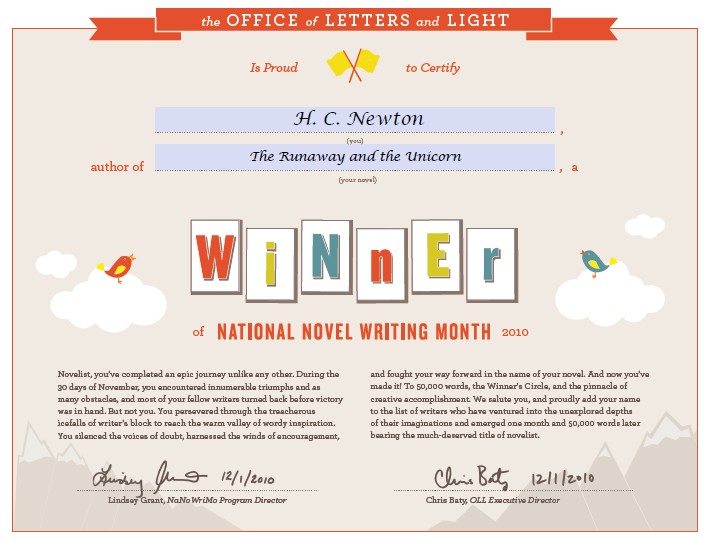
 All righty, I'm now 3 for 4 on NaNoWriMo (not even sure you can count 2007's pathetic showing as a try). As much as I loved the 2008 story, I think this year's is better. Now, how I got from a Science Fiction comedy in the vein of Hitchhiker's or Red Dwarf that I couldn't see past chapter 3 of to a mystery that I couldn't see past Chapter 1 of to a Hornby/Tropper-esque coming of age tale to an Urban Fantasy that morphed mere hours before I started into a straight-up Fantasy, I have no clue. But I really, really like what resulted.
The way the plot developed sorta surprised me, I'd envisioned three parts. Part I took place in 1985, would go on for maybe three or four chapters. Then Part 2 would be a chapter -- a little longer, maybe. And then Part 3 would make up the majority of the novel. Yeah, well, best laid plans and all that, right? I never got to part 2 (I wrote a bit of it tonight at work, after the month was over), part 1 just was too interesting. I'm still trying to decide if I make Part 2 an epilogue, and then pick up part 3 next November, or if I keep plowing away. You can see a short bit about it here.
So anyway, what about Frodo? Well, he didn't win this year, he had a hard time shuffling priorities around and it bit him (tho' he did put up a valiant effort the last night in two hours, writing about twice what he spent all day Saturday composing). So he's 2 for 3. BUT, I will say this about what he wrote, it's a whole different kind of writing than he's done before. His first two NaNo's were pretty cartoonish, with flat characters, and rather slapdash and out of control--the second was a great improvement over the first. But it wasn't until I read this year's work, that I realized how far he hadn't come then. His protagonist this year -- and a couple of the secondary characters -- were people, who acted like people. They thought, they spoke like someone you'd actually meet. Not a family of 4 who'd eat 500 pizzas a day for dinner or something. Does he have a long way to go? Yes. Is he a better writer than his old man was at that age? Probably. Anyway, not technically a win as far as the rules go, so chalk this one up as a moral victory.
I got a good deal of help along the way--back in August I threw up a post that got some interesting suggestions here and in other places. My old high school pal, Brent, saw something I said on Facebook and hooked me up with a great book about writing about fighting (I'll talk more about that some other time). A friend from college, Erika, who also also does this 30 day mad-dash, was a great source of encouragement -- not only in what she said, but also by leading me in the word count for most of the month, giving me something to shoot for. My kids were always supportive, even when (especially when?) they were distracting me from the work. And, of course, TLoML who listened to me moan about how impossible it was this year, pretended to give a crap when I babbled in the vaguest manner possible about minor victories I'd made, and generally indulged me in this for the month. Thank you all of you.
Enough about this for now...on to other things, there'll be something different tomorrow, like something about Neti Pots or...I dunno. We'll see.
Tuesday, November 30, 2010
Writing Quote of the Day - Nov 30
What better way to end this little series than with something from my old writing professor...I'd have typed this one out, but why bother, when there's this handy-dandy video already made?
From Lance Olsen's novel Burnt:
Monday, November 29, 2010
Need More Words
my favorite NaNo-based NaNo-distractions have come from NaNoWriMo Toronto this year -- last year I disocvered the great NaNoToons via the work of Debbie Ohi (who's a heckuva encouragement for aspiring/wannabe writers) and then this year I discovered Errol Elumir's songs. A lot of fun -- pretty good music and video work, too. Here's his latest, a song I can truly, truly identify with.
Writing Quote of the Day - Nov 29
In writing, don't use adjectives which merely tell us how you want us to feel about the things you are describing. I mean, instead of telling us the thing is 'terrible,' describe it so that we’ll be terrified. Don't say it was 'delightful'; make us say 'delightful' when we've read the description. You see, all those words (horrifying, wonderful, hideous, exquisite) are only like saying to your readers, 'Please, will you do my job for me?'C. S. Lewis
Sunday, November 28, 2010
Writing Quote of the Day - Nov 28
It is damned hard to write things that make blank sheets better.Ludwig Wittgenstein
Saturday, November 27, 2010
Writing Quote of the Day - Nov 27
Stuff like this [articles on fiction writing] can be really, really useful. But here's what drives me totally nuts about it. It drives me nuts when writers insist on framing 'what works for me' as 'here is the only correct way to do this'.
Because that's rubbish.
The way I write isn't the way other people I know write. And yet somehow we all manage to turn out books that work for us and our readers. There are many, many ways a writer can get from idea to published novel. There are many many styles and techniques and voices and tools that can be used in the successful telling of a story. The trick with articles like this is to cherry pick them. Suss out the techniques that mesh with your style and borrow them ... and ignore the rest.Karen Miller
(who also writes as K E Mills)
Friday, November 26, 2010
Writing Quote of the Day - Nov 26
Writing just takes practice and a clear idea of what tone you want your books to take. I happen to like people who are smart mouthed, tough, and upbeat. I learned a long time ago that you can't write and be critical at the same time -- uses a different part of your brain. So when you write, turn off the critic. Wait a few days and then read what you've written with a more critical eye. If you can't change it to read the way you'd like it to -- find one of your favorite authors and figure out how they handle what you're trying to do. Pay attention to viewpoint, logic, and voice (is this something my character would say?). If it still doesn't work, set it aside for some other day and try writing a different story. That's what I do (grin).
Subscribe to:
Posts (Atom)


