Wednesday, December 01, 2010

NaNo Post Mortem

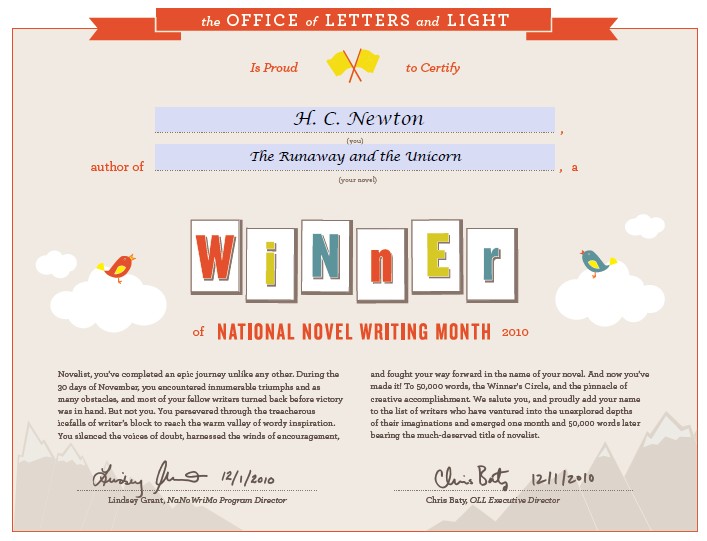
All righty, I'm now 3 for 4 on NaNoWriMo (not even sure you can count 2007's pathetic showing as a try). As much as I loved the 2008 story, I think this year's is better. Now, how I got from a Science Fiction comedy in the vein of Hitchhiker's or Red Dwarf that I couldn't see past chapter 3 of to a mystery that I couldn't see past Chapter 1 of to a Hornby/Tropper-esque coming of age tale to an Urban Fantasy that morphed mere hours before I started into a straight-up Fantasy, I have no clue. But I really, really like what resulted.

The way the plot developed sorta surprised me, I'd envisioned three parts. Part I took place in 1985, would go on for maybe three or four chapters. Then Part 2 would be a chapter -- a little longer, maybe. And then Part 3 would make up the majority of the novel. Yeah, well, best laid plans and all that, right? I never got to part 2 (I wrote a bit of it tonight at work, after the month was over), part 1 just was too interesting. I'm still trying to decide if I make Part 2 an epilogue, and then pick up part 3 next November, or if I keep plowing away. You can see a short bit about it here.

So anyway, what about Frodo? Well, he didn't win this year, he had a hard time shuffling priorities around and it bit him (tho' he did put up a valiant effort the last night in two hours, writing about twice what he spent all day Saturday composing). So he's 2 for 3. BUT, I will say this about what he wrote, it's a whole different kind of writing than he's done before. His first two NaNo's were pretty cartoonish, with flat characters, and rather slapdash and out of control--the second was a great improvement over the first. But it wasn't until I read this year's work, that I realized how far he hadn't come then. His protagonist this year -- and a couple of the secondary characters -- were people, who acted like people. They thought, they spoke like someone you'd actually meet. Not a family of 4 who'd eat 500 pizzas a day for dinner or something. Does he have a long way to go? Yes. Is he a better writer than his old man was at that age? Probably. Anyway, not technically a win as far as the rules go, so chalk this one up as a moral victory.

I got a good deal of help along the way--back in August I threw up a post that got some interesting suggestions here and in other places. My old high school pal, Brent, saw something I said on Facebook and hooked me up with a great book about writing about fighting (I'll talk more about that some other time). A friend from college, Erika, who also also does this 30 day mad-dash, was a great source of encouragement -- not only in what she said, but also by leading me in the word count for most of the month, giving me something to shoot for. My kids were always supportive, even when (especially when?) they were distracting me from the work. And, of course, TLoML who listened to me moan about how impossible it was this year, pretended to give a crap when I babbled in the vaguest manner possible about minor victories I'd made, and generally indulged me in this for the month. Thank you all of you.

Enough about this for now...on to other things, there'll be something different tomorrow, like something about Neti Pots or...I dunno. We'll see.
Tuesday, November 30, 2010

Writing Quote of the Day - Nov 30

What better way to end this little series than with something from my old writing professor...I'd have typed this one out, but why bother, when there's this handy-dandy video already made?

From Lance Olsen's novel Burnt:


Monday, November 29, 2010

Need More Words

my favorite NaNo-based NaNo-distractions have come from NaNoWriMo Toronto this year -- last year I disocvered the great NaNoToons via the work of Debbie Ohi (who's a heckuva encouragement for aspiring/wannabe writers) and then this year I discovered Errol Elumir's songs. A lot of fun -- pretty good music and video work, too. Here's his latest, a song I can truly, truly identify with.

Writing Quote of the Day - Nov 29

In writing, don't use adjectives which merely tell us how you want us to feel about the things you are describing. I mean, instead of telling us the thing is 'terrible,' describe it so that we’ll be terrified. Don't say it was 'delightful'; make us say 'delightful' when we've read the description. You see, all those words (horrifying, wonderful, hideous, exquisite) are only like saying to your readers, 'Please, will you do my job for me?'
C. S. Lewis

Sunday, November 28, 2010

Writing Quote of the Day - Nov 28

It is damned hard to write things that make blank sheets better.
Ludwig Wittgenstein

Saturday, November 27, 2010

Writing Quote of the Day - Nov 27

Stuff like this [articles on fiction writing] can be really, really useful. But here's what drives me totally nuts about it. It drives me nuts when writers insist on framing 'what works for me' as 'here is the only correct way to do this'.

Because that's rubbish.

The way I write isn't the way other people I know write. And yet somehow we all manage to turn out books that work for us and our readers. There are many, many ways a writer can get from idea to published novel. There are many many styles and techniques and voices and tools that can be used in the successful telling of a story. The trick with articles like this is to cherry pick them. Suss out the techniques that mesh with your style and borrow them ... and ignore the rest.
Karen Miller
(who also writes as K E Mills)

Friday, November 26, 2010

Writing Quote of the Day - Nov 26

Writing just takes practice and a clear idea of what tone you want your books to take. I happen to like people who are smart mouthed, tough, and upbeat. I learned a long time ago that you can't write and be critical at the same time -- uses a different part of your brain. So when you write, turn off the critic. Wait a few days and then read what you've written with a more critical eye. If you can't change it to read the way you'd like it to -- find one of your favorite authors and figure out how they handle what you're trying to do. Pay attention to viewpoint, logic, and voice (is this something my character would say?). If it still doesn't work, set it aside for some other day and try writing a different story. That's what I do (grin).

Thursday, November 25, 2010

Writing Quote of the Day - Nov 25

my rules for good writing...:

1. Don't be afraid to suck. It's easier to fix something that's broken than it is to create something from nothing.
2. Write your first draft "with the door closed."
3. Don't try to make everyone happy. If you try to make everyone happy, you end up with According To Jim. Write what you're passionate about, and write to entertain, amuse, and satisfy yourself. To borrow a phrase from Joel Hodgeson, the creator of MST3K: don't ask yourself, "Will anyone get this?" Instead, tell yourself, "The right people will get this."
4. If you're going to write, you have to read. If you're going to write screenplays, you have to read, and you have to watch lots and lots of movies, both for entertainment and for education..

Wednesday, November 24, 2010

Writing Quote of the Day - Nov 24

I learned then and have relearned many times since, that the best part of a writer's life is actually doing it, making up characters, filling the blank page, creating scenes that readers in distant places might connect to. The thrill lies in the rush of sentences, the gradual arrivals of characters who at once seem to have their own life.
Larry McMurtry

Tuesday, November 23, 2010

Writing Quote of the Day - Nov 23

Since the day my first novel was published in 1992, I have told people that writing was like surfing. The hardest part was paddling out there, the longest part was waiting for the right set and the best part was getting up on the wave. You live for the wave, and you wish you could ride it forever. That was writing.

The only problem with that was I had never ridden a real wave. I was simply riding a metaphor: When the writing is good the story surrounds you like a swirling barrel of water. It's all you can think about. Your desire to stay in it wipes out all the rest of the world. I figured that's got to be what surfing is like, so that's what I told people writing was like.

That explanation worked all right for me until I turned 50 a couple of summers ago and decided to see if I'd had it right. I went to Maui with my family to learn how to surf. I can't say I ever saw the inside of a tube, but I rode enough soft waves on a soft top longboard to know that all along I had been on to something with that metaphor.
Michael Connelly

Monday, November 22, 2010

Writing Quote of the Day - Nov 22

Read, read, read. Read everything--trash, classics, good and bad, and see how they do it. Just like a carpenter who works as an apprentice and studies the master. Read! You'll absorb it. Then write. If it is good, you'll find out. If it's not, throw it out the window.
William Faulkner

Sunday, November 21, 2010

Writing Quote of the Day - Nov 21

Twain's Rules of Writing
(from Mark Twain's scathing essay on the Literary Offenses of James Fenimore Cooper)

1. A tale shall accomplish something and arrive somewhere.

2. The episodes of a tale shall be necessary parts of the tale, and shall help develop it.

3. The personages in a tale shall be alive, except in the case of corpses, and that always the reader shall be able to tell the corpses from the others.

4. The personages in a tale, both dead and alive, shall exhibit a sufficient excuse for being there.

5. When the personages of a tale deal in conversation, the talk shall sound like human talk, and be talk such as human beings would be likely to talk in the given circumstances, and have a discoverable meaning, also a discoverable purpose, and a show of relevancy, and remain in the neighborhood of the subject in hand, and be interesting to the reader, and help out the tale, and stop when the people cannot think of anything more to say.

6. When the author describes the character of a personage in his tale, the conduct and conversation of that personage shall justify said description.

7. When a personage talks like an illustrated, gilt-edged, tree-calf, hand-tooled, seven-dollar Friendship's Offering in the beginning of a paragraph, he shall not talk like a Negro minstrel at the end of it.

8. Crass stupidities shall not be played upon the reader by either the author or the people in the tale.

9. The personages of a tale shall confine themselves to possibilities and let miracles alone; or, if they venture a miracle, the author must so plausably set it forth as to make it look possible and reasonable.

10. The author shall make the reader feel a deep interest in the personages of his tale and their fate; and that he shall make the reader love the good people in the tale and hate the bad ones.

11. The characters in tale be so clearly defined that the reader can tell beforehand what each will do in a given emergency.

An author should

12. _Say_ what he is proposing to say, not merely come near it.
13. Use the right word, not its second cousin.
14. Eschew surplusage.
15. Not omit necessary details.
16. Avoid slovenliness of form.
17. Use good grammar.
18. Employ a simple, straightforward style.
Mark Twain
(source)

Saturday, November 20, 2010

Writing Quote of the Day - Nov 20

A manuscript, like a foetus, is never improved by showing it to somebody before it is completed.
Unknown

Friday, November 19, 2010

So Have You Seen this Fan-Made Hunger Games Clip?

I don't know if you've seen this yet, but if you've read The Hunger Games you really, really should--it almost perfectly captures one of the best scenes in the book. If you haven't read it, and are considering it (and you really should), stay away from the clip 'cuz it'll ruin one of the best scenes in the book.

Other than the fact they got Rue's ethnicity wrong...can't think of a problem with this. I'd gladly fork over $10 to buy a ticket to this group's version of the whole book.


Watching this made me realize one major problem with making a movie of book: How does Hollywood expect to do this flick and get a PG-13?

Writing Quote of the Day - Nov 19

First of all, realise that it's very hard, and that writing is a grueling and lonely business and, unless you are extremely lucky, badly paid as well. You had better really, really, really want to do it. Next, you have to write something.
Douglas Adams

Thursday, November 18, 2010

Writing Quote of the Day - Nov 18

Even in literature and art, no man who bothers about originality will ever be original: whereas if you simply try to tell the truth (without caring twopence how often it has been told before) you will, nine times out of ten, become original without ever having noticed it.
C. S. Lewis

Wednesday, November 17, 2010

Having "The Talk" with your Kids (not *that* one)

I admit it, and it brings me great shame to do so...I messed up with my older two (despite my good intentions), and am trying to do better with my younger two, but it's so hard when their older brothers have it so messed up...

Parents, don't make the same mistakes I did... talk to them about Star Wars from an early age.


somehow this post feels like it should end with this:

Writing Quote of the Day - Nov 17

There is no such thing as a perfect book or a perfect story.
Every book in every library on this planet has something wrong with it. It could be something tiny. Maybe a minor character isn't well drawn. Maybe a description goes on too long. May the dialogue is stiff in one spot. There's something wrong with every single one.
No matter how hard we writers try, we will never achieve perfection.
Perfection doesn't matter. No two readers would agree on whether our book was perfect anyway. Besides, readers care less about perfection and more about connection, getting caught up in a story, caring about the characters.
When you're just starting to write, you may be miles away from perfection, and you may be well aware of it. It's maddening. It's disappointing.
Writing is deceptive. You know how to read. You know what you like in a book and in a story. You know how to write, how to make sentences and paragraphs. So why can't you tell your story in the beautiful way it t appears in your mind?
Well, you wouldn't expect yourself to play the trumpet perfectly the first time you picked it up. You wouldn't expect to join the Olympic team the day after you learned to swim.
Writing is a skill, and the more we do it, the better we get at it. I expect to be learning to write till I die. There's always more to learn, and that may be the best thing about being a writer.
Gail Carson Levine

Tuesday, November 16, 2010

Writing Quote of the Day - Nov 16

You're in the middle, a little past the half-way point. The glamour has faded, the magic has gone, your back hurts from all the typing, your family, friends and random email acquaintances have gone from being encouraging or at least accepting to now complaining that they never see you any more---and that even when they do you're preoccupied and no fun. You don't know why you started your novel, you no longer remember why you imagined that anyone would want to read it, and you're pretty sure that even if you finish it it won't have been worth the time or energy and every time you stop long enough to compare it to the thing that you had in your head when you began---a glittering, brilliant, wonderful novel, in which every word spits fire and burns, a book as good or better than the best book you ever read---it falls so painfully short that you're pretty sure that it would be a mercy simply to delete the whole thing.

Welcome to the club.

That's how novels get written.

You write. That's the hard bit that nobody sees. You write on the good days and you write on the lousy days. Like a shark, you have to keep moving forward or you die. Writing may or may not be your salvation; it might or might not be your destiny. But that does not matter. What matters right now are the words, one after another. Find the next word. Write it down. Repeat. Repeat. Repeat.

Neil Gaiman

Monday, November 15, 2010

Writing Quote of the Day - Nov 15

When you think of the great writers, penning a novel seems terribly romantic. You think of F. Scott Fitzgereald, a Riviera breeze billowing his curtains and the sounds of the Cap d'Antibes street cut by the tapping of his typewriter, as he lacerates the rich and dreams of the past. Or Hemingway, in a hotel in Pamplona in the heat of the afternoon, as bullfighters take their siesta and drops of water bead on a bottle of kirsch. Or Joyce, squinting his Irish bead-eyes as he blends his classical training and his Gaelic imagination to summon up allusive rhythms and language dense and enfolding.

Even lesser novelists seem glamorous. Some scribbler burning twigs in a boardinghouse in the second arrondissement as he dips his quill pen into the ink. Or a slim and shoeless thirty-something, taking a year off from his job as an alternative-marketing consultant to sit in a park in Vancouver or Park Slope and type into his PowerBook a wry yet soulful take on the paradoxes of hypermodernity.

That is all delusion. Writing a novel is pathetic and boring. Anyone sensible hates it. It's all you can do not to play Snood all afternoon.
Steve Hely
How I Became a Famous Novelist